
The Silent Standard: How Fabric, Form, and Silhouette Shape Executive Presence
The Quiet Evolution of Executive Presence
The corporate uniform has lost much of its authority. The dark suit, rigid tie, and visibly expensive accessories once served as shorthand for seniority, but their meaning has weakened as workplaces have become more hybrid, international, and varied. At the other extreme, the post-pandemic rush toward hyper-casual dressing has created its own limitation. Comfort can support concentration, yet an outfit assembled without consideration may communicate fatigue, uncertainty, or indifference when the moment calls for clarity.
The more durable alternative is neither a return to theatrical formality nor an acceptance of permanent informality. It is a quieter standard built on fabric quality, structural drape, proportion, and restraint. Authority increasingly appears in the way a garment holds its line, the way a collar sits, and the way an outfit remains composed through a demanding day. For modern leaders, clothing becomes an intentional communication strategy: a silent standard that aligns physical presentation with judgment, steadiness, and purpose.

Decoding the Visual Language of Non-Verbal Authority
Dress functions as an unspoken vocabulary. Before a leader makes a point in a boardroom, enters a client meeting, or appears on a video call, observers have already absorbed information from texture, fit, color, grooming, and proportion. These signals do not replace competence, and they cannot manufacture sound judgment. They can, however, influence whether competence is immediately legible. A clean shoulder line may suggest organization; a substantial fabric may suggest durability; an uncluttered outfit may imply that attention is directed toward the work rather than toward display.
This is why material and cut often matter more than visible branding. A logo announces affiliation or price, but a carefully chosen wool jacket, well-finished cotton shirt, or fluid knit can communicate discernment without demanding attention. Understanding the semiotics of dress reveals how subtle sartorial decisions signal competence without overt signaling. In high-stakes environments, the strongest message is often emotional composure. Clothing that appears deliberate but not precious supports the impression of someone who can absorb pressure without becoming theatrical.
The distinction is important because leadership is not performance in the narrow sense. Martin Gutmann”s work on understated leadership challenges the tendency to celebrate dramatic action simply because it makes a compelling story. The same principle applies visually. A conspicuous outfit can create an immediate impression, but a stable and coherent appearance tends to build credibility over repeated encounters. Quiet authority does not require disappearance. It requires enough structure to be remembered for the right reasons.
Tactile Weight and the Cognitive Psychology of Drape
Clothing affects more than the observer”s interpretation. It can also influence the wearer”s attention, self-perception, and behavior. The concept of enclothed cognition proposes that garments work through two connected channels: the symbolic meaning associated with them and the physical experience of wearing them. Research discussed by Rice University”s “You Are What You Wear” describes experiments in which participants performed differently depending on what they believed a garment represented. Identical white coats produced different effects when described as doctors” coats rather than painters” coats.
The finding does not mean that a particular fiber automatically produces better leadership. It does suggest that tactile experience and symbolic meaning can shape the mental state brought into a situation. A garment that feels substantial, fits without restriction, and retains its shape may reduce small physical distractions. The wearer is less likely to adjust a collapsing shoulder, tug at a thin waistband, or monitor fabric transparency under changing light. That practical ease creates room for attention, listening, and decision-making.
Drape is especially influential because it sits between comfort and architecture. A fluid fabric follows the body, while a weighted fabric creates a controlled line around it. Natural fibers are not universally superior, and high-quality synthetics can offer resilience, stretch, and weather resistance. The more useful question is whether the textile supports the intended role, climate, movement, and level of formality.
| Textile quality | Typical visual effect | Executive consideration |
|---|---|---|
| Fine wool | Structured, breathable, and refined | Useful for jackets, trousers, and travel because it can hold shape without looking rigid |
| Dense cotton | Clean, substantial, and approachable | Works well for shirts, overshirts, and polished business-casual layers |
| Linen blends | Light, textured, and relaxed | Effective in warm settings when controlled wrinkling suits the environment |
| Technical synthetics | Smooth, resilient, and performance-oriented | Valuable for travel and movement, provided shine and cling are managed |
| Thin, unstable fabrics | Informal or easily distressed | Can undermine presence when they crease, cling, or lose shape during the day |
Natural, weighted fabrics often produce the clean architectural lines that make posture appear more settled. A jacket with enough internal structure can frame the shoulders without exaggerated padding. Trousers with a controlled crease can lengthen the line of the body. A knit with recovery can create ease while preserving intention. These details are subtle, but they influence the total impression in the same way that clear formatting influences a complex document: they make the underlying order easier to perceive.
Silhouette and Structure Over Conspicuous Details
Silhouette is the broadest visual statement an outfit makes. Proportion determines whether separate garments appear to belong together, while balance determines whether the eye moves calmly across the composition. A cropped jacket with a high-rise trouser creates a different message from a long jacket with a low-rise trouser, even when both are made from excellent fabric. Neither combination is universally correct. The relevant question is whether the proportions support the leader”s physical presence, workplace, and objective.
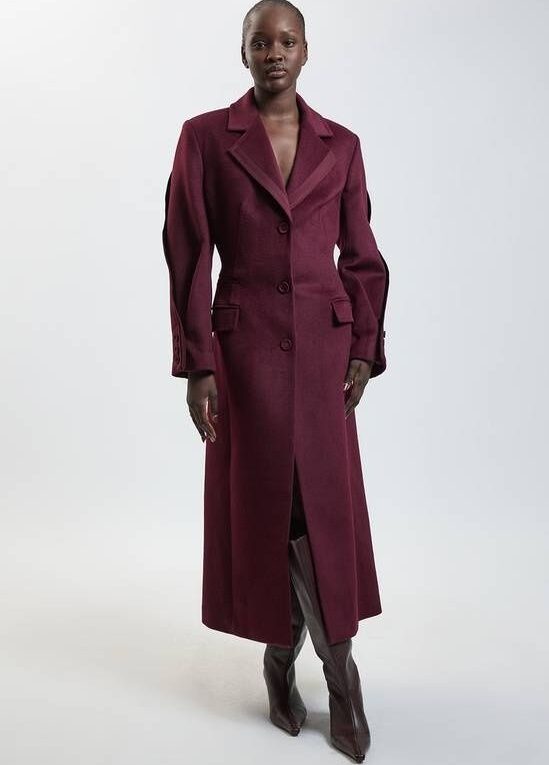
Refined structural tailoring should not be confused with stiffness. A rigid suit that restricts movement can make the wearer appear guarded, while an unstructured outfit may look unfinished. The strongest middle ground uses shaping where it is useful and softness where it supports movement. A softly constructed blazer, a substantial overshirt, or a precisely cut knit jacket can communicate form without reproducing the old corporate uniform. This supports the broader leadership principle that calm influence often outperforms dramatic display.
- Choose one clear focal point rather than several competing details.
- Keep shoulders, hems, sleeves, and trouser breaks intentional.
- Use color to reinforce the room”s expectations, not to compensate for weak fit.
- Favor texture, weave, and finish when a garment needs distinction without spectacle.
- Review the outfit in motion, because executive presence must survive sitting, walking, presenting, and reaching.
A disciplined silhouette communicates clarity because it appears edited. The message is not that every detail has been controlled obsessively, but that unnecessary visual noise has been removed. That quality is valuable in leadership settings. When the presentation is composed, the audience can focus more easily on the speaker”s reasoning, questions, and decisions. Clothing becomes a supporting structure rather than a competing argument.
Building an Intentional Wardrobe Built on Substance
An effective wardrobe begins with an audit, not a shopping spree. Examine the garments most frequently worn in high-visibility settings and assess them under three headings: tactile integrity, structural integrity, and contextual fit. Tactile integrity asks whether the fabric feels substantial and comfortable. Structural integrity asks whether the garment holds its shape and supports the body. Contextual fit asks whether the item suits the room, the calendar, the climate, and the expectations attached to the role.
Natural fibers deserve close attention because wool, cotton, linen, silk, and cashmere each offer distinctive qualities in breathability, texture, and drape. Yet fiber origin alone does not guarantee quality. A poorly woven natural fabric can crease or distort, while a technically developed synthetic can be remarkably useful. In high-visibility settings, inspect the whole textile: its density, surface finish, recovery, opacity, and behavior under light. The goal is not ideological purity. It is a garment that looks and feels credible throughout the working day.
Use the following sequence to create a dependable executive baseline:
- Map the real calendar. Separate client meetings, board sessions, internal working days, travel, presentations, and remote calls. Each setting requires a different level of structure.
- Identify two or three anchor pieces. Begin with versatile jackets, trousers, knit layers, or dresses that can support several combinations. Reliability is more valuable than novelty.
- Correct proportion before adding detail. Alter sleeve length, trouser break, shoulder fit, and hem placement before buying statement accessories or additional colors.
- Build a controlled palette. Combine dependable neutrals with one or two restrained accent colors or textures that feel aligned with the role.
- Test garments in use. Sit, walk, travel, present, and spend several hours wearing each key item. A garment that looks excellent for five minutes but deteriorates by midday is not an executive asset.
Everyday proportion is where a signature baseline develops. The aim is not to wear the same outfit repeatedly, but to repeat a recognizable logic: balanced volume, considered texture, and a level of finish appropriate to the environment. One leader may find that softly tailored trousers and compact knitwear create the right foundation. Another may rely on sharp shirting, fluid suiting, and minimal footwear. Consistency makes dressing easier because it turns presentation into a system rather than a daily negotiation.
For hybrid work, the same principle applies to the frame visible on screen. The upper silhouette, collar, shoulder line, and fabric surface carry particular weight during video meetings, while lighting and grooming affect how the garment is perceived. Dressing one step above the room”s baseline can provide useful authority without appearing disconnected from colleagues. The standard should remain adaptive, but adaptation is not the same as carelessness.
Claim Your Space with Enduring Subtlety
Executive presence is strongest when internal capability and physical poise appear aligned. Clothing cannot provide courage, strategic intelligence, or empathy, but it can create conditions in which those qualities are easier to express. A well-chosen garment reduces distraction, supports posture, and establishes a visual rhythm that allows the wearer to enter demanding situations with greater composure.
The long-term credibility dividend comes from quiet intentionality. Fabric, form, and silhouette do not need to announce status; they need to sustain confidence, movement, and relevance across changing contexts. When garment selection is conscious rather than novelty-driven, the result is a presence that remains credible after trends have passed. The strongest standard is therefore not a uniform. It is a practice of alignment, allowing ideas, judgment, and character to speak loudest.